
‘Creative moments and tall tales’
Newsletter 1 – February 2023
Writing Into the Shadows; a virgin author’s experience
Into the Shadows approaches publication. There is nothing so special for an author than to see their book in ‘the flesh’ for the first time; to hold the book and flick through the pages! The characters from the imagination have been set free to speak to others.
It has been a fascinating process to take a story from daydream through to publication. The actual writing seems a long time ago, the past few months has all been about editing. I found that writing a book was like growing a tree as tall and leafy as you can, and then you spend the rest of the time pruning that tree, snipping and shaping it for the reader. Steven King in his book, On Writing (2020) observes that ‘the writing is for the writer, the editing is for the reader’. It is a brutal process changing your ‘own’ version to the one for the reader. My original book is 120,000 or so words long. But a publisher fed back that it, ‘lacked pace’ after the first chapter, and advice given was that ‘every chapter must support the story, and every word must be necessary’. So, the pruning began down to the final 75,000 or so! Many scenes building background were axed. Instead, the purposes of these initial scenes were distilled into actions or dialogue by the characters themselves – let them tell their own story! A few side plot lines I thought would, ‘develop the characters’ also went as they did not ‘contribute directly to the story’. Even some supporting characters got the chop; ‘stay focussed, maintain pace in the key story line,’ I kept telling myself.
I take my hat off to professional editors – what a job! It is not a case of ‘reading through to see what you spot that is wrong’ I soon learned – you spot way too little that way. No, you need a systematic and organised assault on those pesky words and letters that disguise themselves as right, when they are actually misspelt, backwards, upside down or shouldn’t be there at all.
I started off using some grammar tools, lacking in confidence of my own ability. First up, Grammarly – I now hate it with a vengeance. I didn’t know that there were so many Americanisms – it took me weeks and weeks to weed them all back out and anglicise the text once more (Toward without the ‘s’ is American, now I know…): ‘Word’ spell check will be my starting point next time.
Hemmingway was next. But I found this tool tended to strip out all my personal style and wanted everything paired right back to short, simple sentences with no word longer than 4 letters, no adverbs, and nothing to challenge a six-year-old reader. Sorry to all 6-year-olds, you have to learn hard words to read my book!
I have learned that I must take control of my own grammar, my own learning – own up to it and improve it if needs be. I want to be a ‘good writer’ and to do that I need to perfect the use of the tools of the trade. I made a list of all important aspects that may be to the detriment of the reader’s enjoyment of the story, such as missing and inconsistent punctuation for speech, making sure it was clear who was speaking, and taking out repeated words and ‘needless’ words such as (there was a very long list of these!) ‘really’, ‘very’, basically’ and ‘definitely’. Mind you, then I went back and replaced a few of them because that is what I wanted my characters to say… but each word and its ‘usefulness’ has been considered. My sincere hope is that the grammar does not distract in any way from the readers absorption into the story, and if there are errors, I will own up to them, blame no-one else, and learn from them (Commas baffle me. Every editor who provided feedback, and every online tool I used moved them back and forth within a sentence with no rhyme nor reason. I ended up believing they are invented as pretty confetti, to ‘sprinkle in decorative fashion’ according to personal taste: I put them where I thought they should go – perhaps my next learning for the next book…).
Pre-order offer available until 17th March: marinemoments.uk/fiction
Being a spy
Have you ever considered it as a career? Probably not. Not many people I imagine would do so. Most of the spies that have existed have either been ‘recruited’ or been ‘asked’ to help, such as in the time of war. Just as the role of a forensic scientist was glamorised in TV series such as CSI, the role of ‘spy’ has been glorified by such fictional characters as James Bond. In reality things are not always so exciting. However, there is something intriguing and almost romantic about imagining being that silhouette lighting the cigarette under the streetlight, or the person who appears to be a housewife but is actually passing on messages that save the world before the school pick-up.
But if being a spy was an option in the school’s career guide, what skills would they require – and have you got them? Here are four famous spies – which one of these four would you be?
James Bond (Created by Ian Fleming and immortalised on the big screen over the years, shaken but never stirred.): Highly intelligent, exceedingly cunning, independent, not a team-player, sensible, calm, physically fit (as in strong and fast, as well as damn good looking!), mature, likes cars – the faster the better.
Josephine Baker: (WW II spy and activist: the first American woman to be awarded the Croix de Guerre. Singer/performer who worked in Germany collecting information recorded on sheet music in invisible ink) – musical, not easily frightened/brave, outward going, observant, charismatic, determined.
George Smiley (John Le Carre): unobtrusive, ‘melt into the background’ ability, patient, observant, appear harmless, humble, kind, quiet hero, ordinary-looking, analytical.
Lise de Baissac (Carried out clandestine Special Operations during WWII. She acted as a liaison officer between various networks, reporting back to England from Paris. She took part in numerous armed attacks on enemy columns.): action-loving, happy to learn to parachute, brave, smart, energetic, resilient, an organiser, can rapidly build rapport with people, use initiative.
The trouble with ‘genre’ – boxes with lids
People like to know what kind of book they are about to read, and with that promise comes a whole host of expectations. It is the writer’s job to fulfil those expectations. But what happens when a story does not fit neatly into a box?
Into the Shadows, straddles a few boxes. It has a ‘chic-flick’ feel to it, with intense relationship dramas but does not comply to the usual love story tropes– there’s a twist. There is drama, adventure and mystery related to the spy world, but it is not a horror, nor will it give you nightmares – although the lead character certainly has them! It is not quite a ‘cosy mystery. ’There is a ‘who-dunnit’ element but with some swearing and sex scenes, it breaks the ‘cosy’ rules …
I am creating a new box – ’fictional biographies’ It is the story of a young girl who goes on to be a fully-fledged spy (In subsequent books). This book follows her first steps towards the shadowy world and her experiences that pave the way to her further involvement – or it is an account of her experiences that allow her to be easily enmeshed and pulled into such a world – you will have to make up your own mind about that: Does she choose her path or is she ‘recruited’?
I think the lid of boxes of genre should stay off, allowing the books to breathe and float from one box to another. But if pushed, Into the Shadows will be in the ‘Mystery’ box with the subtitle of ‘fictional biography’, ‘adventure’ – and for ‘cosy’ readers, a government health warning.
Newsletter – March 2023
A Love of Nature
I believe a love of nature runs through an author like the name of a holiday resort through a stick of rock. Those that have a real love for the natural environment, do not see it as separate nor merely a backdrop to a story, but weave it through as an integral aspect of the tale, an extension of the drama and emotion being conveyed. For example, the English countryside sings through H E Bates’ the Larkin family series. Pop Larkin is not a small holder from Kent with a quick wit and an art for a good deal; he is a personification of a robin singing in Pop’s ‘paradise’ bluebell wood. The characters seem to sprout and grow from the turn of the seasons.
You only have to say ‘Cider with Rosie’ to have a tickly nose from the dusty field, the air full of straw strands, and the warmth of the soil pulsing under your feet. Graham Greene extends the loss and isolation of his main character to the coal-mined landscape in the ‘Confidential Agent’- ‘…the hills gave out and a long plain opened up dotted with strange and erratic heaps of slag…short unsatisfactory grass crept up them like gas flames…’ And those that have enjoyed the exquisitely funny tale of Fludd by Hilary Mantel will have dark, cold wet moorland in their minds, as impenetrable as mountains to the outside world, , despised by all inhabitants but invading their lives nonetheless with its frozen black gloom, seeping through the people so they come to resemble their despised landscape; ‘they wore plastic raincoats of a thick, vicious green, impermeable, like alien skins…’ against the rain and ‘the viscid-seeming mist.’
Clara, in Into the Shadows, is very much a product of her environment. She grew up in a small hamlet in the Quantock Hills in Somerset. It kept her sheltered and vulnerable when dealing with people, and arguably is a factor in her ensnarement, but it provides a solid anchor for her in times of distress and trauma. Through her yoga meditations she reaches out to that quiet yet strong natural environment, seeking healing. She also finds a second home at Swallows Swoop with Bryn and his family as she recognises the countryside setting as home for her, and Bryn with his love of gardening and growing mint for his tea strikes a subconscious chord and sense of safety for Clara.
Thank goodness for ‘idiot sport commentators’!
Writing Into the Shadows is the result of fruit after tragedy in my life. I only really managed to apply myself to writing a full fiction book when I became a carer for my father. He wanted me to sit and keep him company to watch the sport on TV, but he said, ‘all crowds were noisy, and all commentators were idiots,’ so we had to watch the games on mute. I do like sport, but not that much! So, while my dad watched silent snooker, I used to scribble stories that came into my head into a notebook to entertain me, keep me awake and transport me away from the sick room for a while. In reaction to the sadness and illness the story is one of adventure, intense relationships, and action.
I have always loved reading spy novels and is fascinated by the concepts of disguise, hidden truths, and the role of trust in such worlds. I grew up on a diet of James Bond and The Professionals, all male role models: I could have done with Clara around when I was younger to provide a female role model.
My father died at the start of Covid. He was frail when I last saw him, but then we went into the first lockdown and I couldn’t see him in his care home for a week, and he couldn’t understand why. Left all alone without family, he just kind of gave up and clocked out. I still grieve for him and wish I could have been there to hold his hand at the end. But I had by then the embryo of my book, and I worked over the past two years to complete it as a memorial to my father. He would have been proud, a writer himself. He wrote us bedtime stories as kids and won a radio competition once for one of his short stories, Grandad’s Pig.
Unfortunately, I didn’t get recruited into the spy world on leaving university, I went instead into teaching and then educational management. I have a degree in geography and psychology and a Masters in environment and developmental education. I have taught in Zimbabwe, Canada, and England, and now live in Westward Ho, North Devon.
The book, Into the Shadows was launched on 31st March, my father’s birthday. To order a book go to marinemoments.uk/fiction.
Lessons learned from a book launch
It was a great experience. It was a very positive self-affirming moment, with a room full of friends willing you on and applauding your achievement, and (seemingly) genuinely interested in how and why you wrote your book. These are all things to celebrate, and I am glad I popped a cork or two and added vital inches around my middle to enjoy the cake. Writing is a solo business, publishing is anything but – it has to be entirely outward looking, positive engagement with others and interaction to continually build links that may lead to a book sale. Looking back, I drew on a lifetime of teaching, organisational and planning skills to manage the process. Here are five key ideas/advice arising out of the experience I would share with others.
Number one: Keep perspective and the whole process ‘in its box’. The fears that keep you awake at night – the book isn’t good enough; I will be a laughing stock; people will think I am stupid…deluded…reaching too far…(I am sure you can provide your own list), stick a pin in them all and let them explode into tiny shreds! These thoughts might keep you awake at night, the book may be the only thing in your mind as you lead up to your launch, but It Is Only A Book, and it barely impinges on anyone else’s life. No-one cares that much. They are happy for you, will celebrate with you – it is a little out of the ordinary and we all like to celebrate good things, but that is it. It isn’t worth worrying anymore; you have got as far as publishing, there is no turning back. Focus on your achievement, what you have managed, and enjoy it.
Number two: Choose the right person to introduce you and ask you questions about the book; someone who is genuinely impressed by the book and has read it and can ask some interesting questions. It is best to meet with them beforehand. Practice the questions and decide which order to ask them. The order we decided on was, questions related to how/why I wrote it to start, then some more specific questions about the book such as, ‘why the 1980’s’ and, ‘what was my favourite character and why?’ to finish up with a short extract to provide the audience with a real sense of how it was written and the element of mystery – trying to hook them into a sale. In my case I opened the discussion on whether the prologue I had originally included, but then decided to take out, was the best decision. I read a section of it and said I would be happy to discuss their thoughts after the talk, leaving the book upmost in people’s minds at the end – not the author.
Number three: It is hard to predict how many books you will sell so I brought far too many but kept them under the table, so I could relax and not worry about running out – I did have to restock the table from the under-table book boxes at one stage, so was grateful for the back-up.
Number four: I recommend setting up a simple card reader so you can take non-cash payments as well as cash. Units such as ‘Square’ are cheap to buy and simple to set up using your mobile phone. If, however you rely on cash payments, don’t be shy about telling people, and put it on the invite – people just don’t carry cash these days and will have to go and get some especially. Don’t give them the excuse to say, ‘I’ll buy it online when I get home’ (they won’t, and it will cost you more…).
Number five: Encourage people to feedback to you. For a launch to work it has to literally launch the book over the heads of your friends out into the wider world of readers. To get there you rely on your ‘launch readers’ to leave reviews – either on your website, Amazon or Goodreads, or wherever you have set up to collect them. I printed off slips of paper to remind people to leave a review, plus the links to Amazon and Goodreads, and placed them on the last page of the book. Just as they reach ‘The End’ they are reminded to capture their feelings before they forget. I will report back on whether this strategy works.
Would I do the same kind of launch again, for another book? Maybe not on quite such a scale (Order fewer cakes and bottles of Prosecco!). However, I teamed up with a local artist who wanted to exhibit her art, and I got as many sales from her friends, as I did from my own, so next time, I will definitely team up with other artists to plan an evening, to capture that wider market.
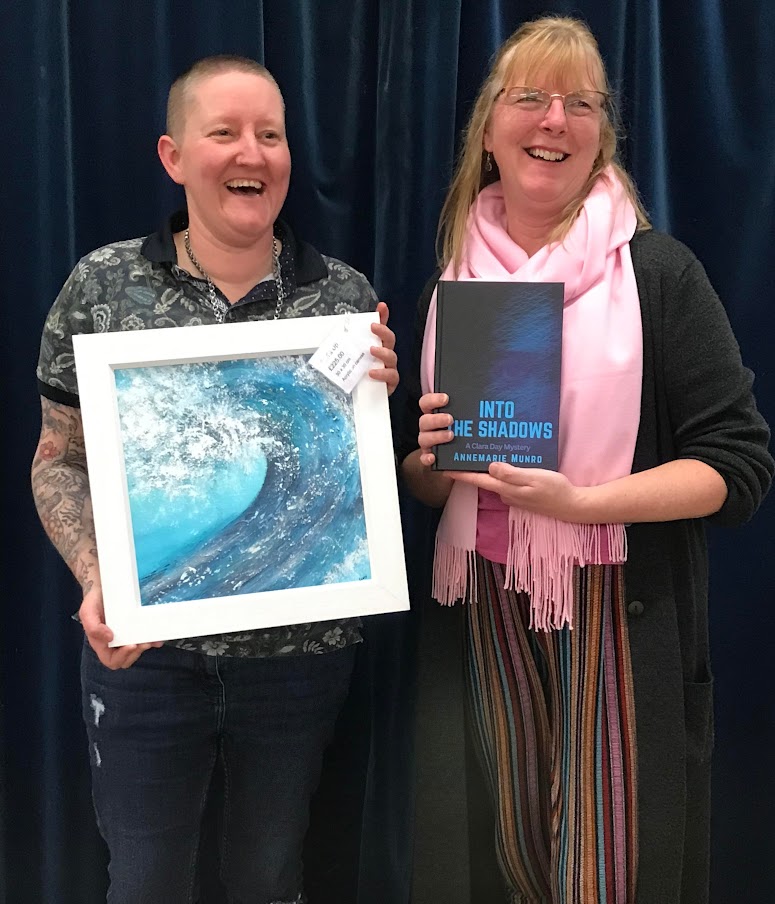
Lucy Sheffield https://www.facebook.com/groups/lucysartoflife/
 Marine Moments